BROOK BANNISTER + M.E. MOORE:
LIVING BOOK OF THE RIVER
3.29.2026
Curated by Marne Dupere
The hardest material obeys the same law with the most fluid. Trees are but rivers of sap and woody fibre flowing from the atmosphere and emptying into the earth by their trunks, as their roots flow upward to the surface. And in the heavens there are rivers of stars and milky ways. There are rivers of rock on the surface and rivers of ore in the bowels of the earth. And thoughts flow and circulate and seasons lapse as tributaries of the current year.
- July 25, 1839, Henry David Thoreau, The Journal 1837-1861
________________________
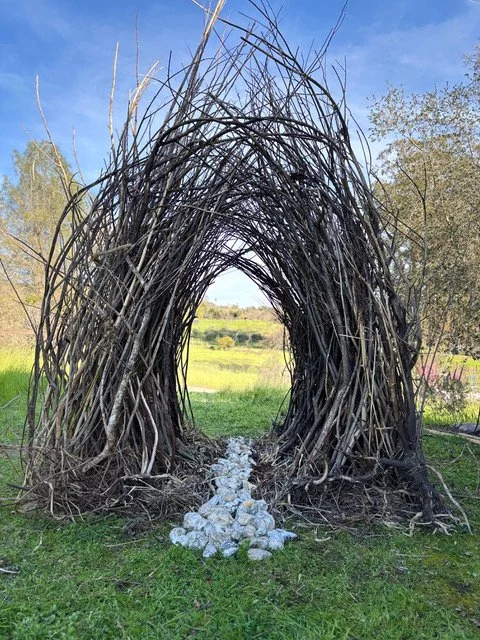
The winter floods on the Russian River in Alexander Valley leave behind giant drifts of wood tangled together: broken branches, roots, trunks, that were upstream forests a moment ago. They grow fast, are swept away and then sprout anew in a constant life cycle along the river. Sometimes they are laid out like blankets on the gravel bar, other times, they are wrapped high up in the Willow, Walnut and Cottonwood trees that survived the flood.
I’ve always thought these flood-created tangles were beautiful. The more I observed them, I found deep beauty in their individual pieces as well. Thinking back, I remember marveling at these tangles and giant drifts my entire life, and in recent years, wondering how I could translate them into artwork.Starting roughly a year ago, I began to gather this wild, broken, tree and flood wreckage and give it new life in my own compositions.
A water and sun-bleached branch lying on the river rocks is a poem. Piecing many of them together in a new form is a story about a flood event, a season, a changed landscape, and hopefully reinforces that every bit of the natural world is extraordinary and deserves reverence.
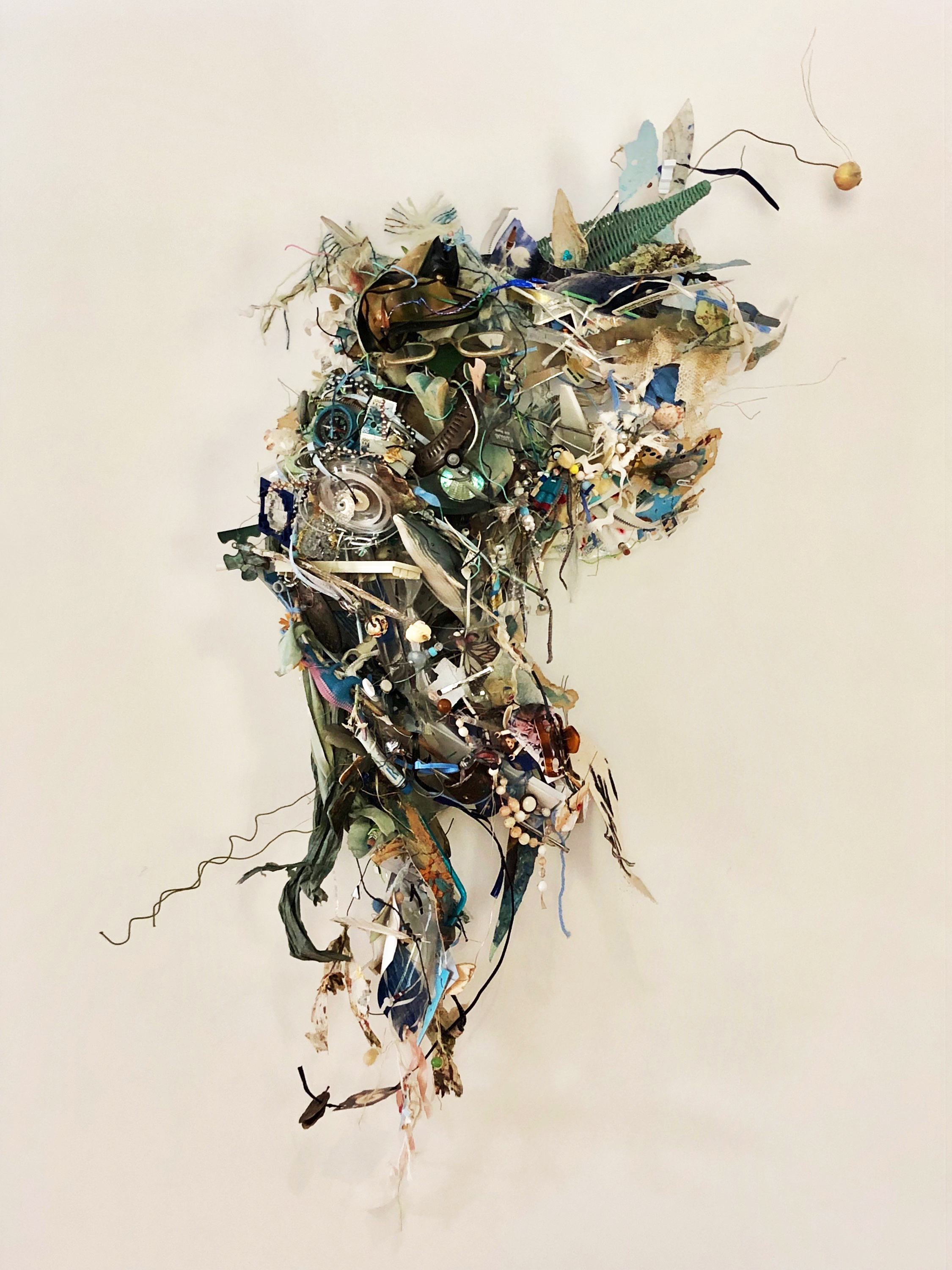
The first works I made were the more abstract wall sculptures: the Jellyfish, Kelp, Lungs. Making these got me thinking about my love of animal architecture. Here I was, putting sticks together, a bit like a bird building a nest. I have loved those Bower Bird nests since the first time I saw them. The nests and the lights for this show came from that spark. Making something practical the way an animal might, when it has a pile of sticks at its disposal. I suppose I had always been looking for an excuse to make a human-scale nest; to point out how badass animals are while simultaneously looking for a new mating ritual.
If you take anything away from this show, I hope it is a renewed appreciation of nature. I mean this in a religious way and a practical way. Sitting our butts down and observing (with all our senses) the movements of animals, the changing of the seasons, has the spiritual value and depth to maintain in us some joy. Practically, it feels as if we have given up on our hopes to save the environment, when nightmares we never even imagined suddenly crash into our lives. We should not abandon hope, though. Our children need clean air and clean water far more than they need money.
And in the very quiet midnight of our lives, when the worries come on that are difficult to turn off, to know that the creatures whom we share the planet with are going about their lives, without the disturbances and poisons of humans, will be a profound comfort.
- Brook Bannister